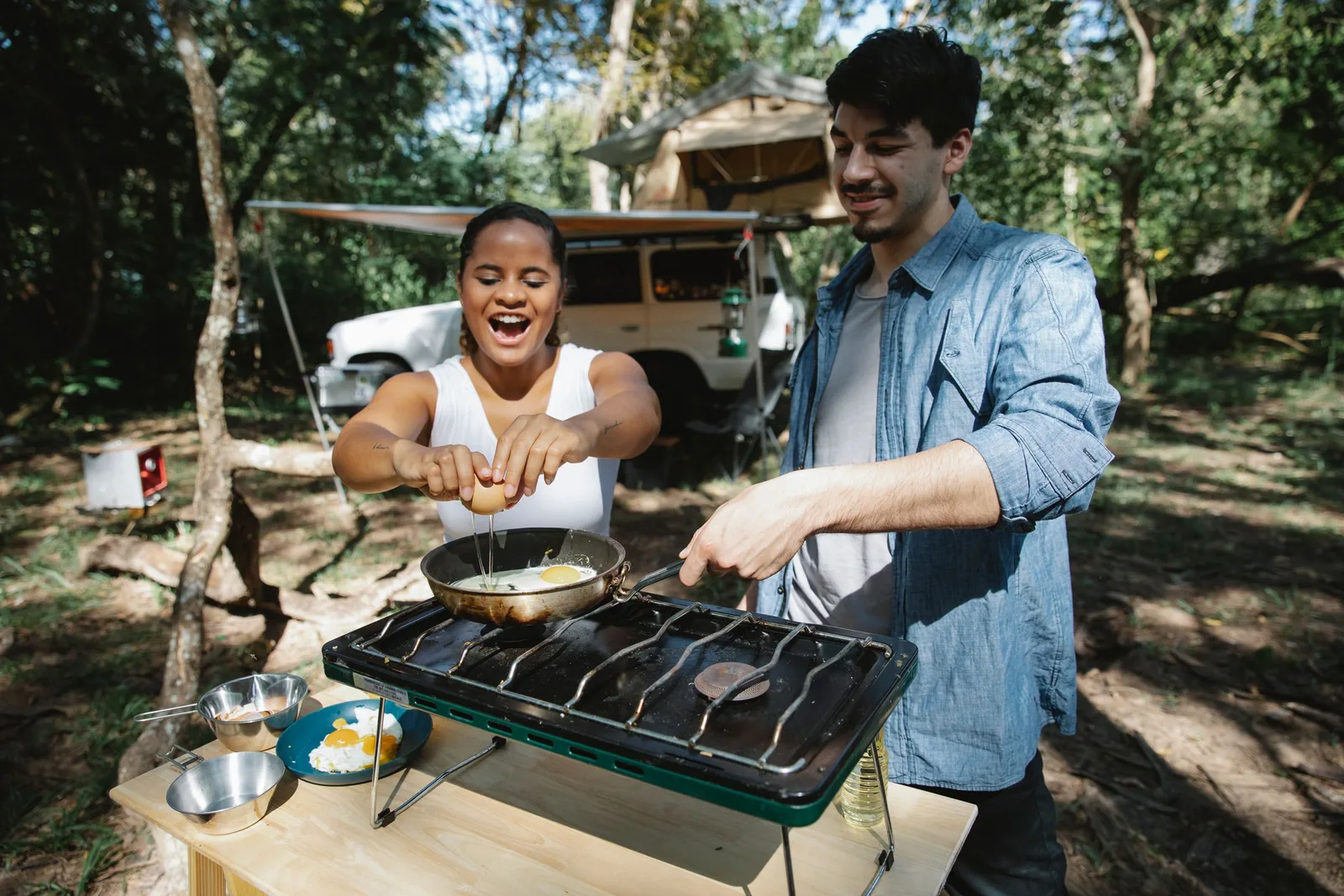
Best Camp Stoves for Car Camping and Backpacking (2026)
We may add affiliate links in the future. When we do, we will disclose them clearly. Learn more.
A camp stove has one job that a campfire cannot always do: give you a controlled flame when you want breakfast, a hot drink, or a real meal, including on days when fires are restricted. The hard part is that "camp stove" covers two different tools. A tabletop two-burner propane stove is built for car-camp and picnic-table cooking. A backpacking stove is built to weigh ounces, screw onto a small fuel canister or run on liquid fuel, and live in a pack.
This guide compares six current stoves that show up again and again in 2026 editorial roundups: two propane two-burners for car camping, three isobutane-canister backpacking stoves, and one hybrid stove that also burns white gas, kerosene, and unleaded gasoline.
How we chose: This is a research-based guide. We compared manufacturer specification sheets, manuals, and current prices on brand stores and major retailers, plus Amazon's AI-generated "Customers say" review summaries where we could read them, owner posts, and published editorial reviews. We did not test these stoves ourselves. Prices were checked on November 24, 2026, during holiday-sale season, and they change often.
Quick picks
- Best overall for car camping: Camp Chef Everest 2X. Two 20,000 BTU burners, a 215-square-inch cook surface, matchless ignition, and a lid that folds into a three-sided windscreen, at $183.99 on Amazon (list $229.99).
- Best value two-burner: Coleman Classic Propane. 20,000 BTU total, about 11.65 lb, a 3-year warranty, and a long record as a simple picnic-table stove. It does not have a built-in igniter.
- Best overall backpacking canister stove: Soto WindMaster with 4Flex. A regulated 11,000 BTU burner with a concave, wind-resistant head, at 3.0 oz (87 g) with the included 4Flex pot support, for $69.95.
- Best simple, compact backpacking stove: MSR PocketRocket 2. 2.6 oz (73 g), a 3.5-minute official 1-liter boil, and a hard-shell case, at about $49.
- Best integrated boil system: Jetboil Flash 1.0L. A 1-liter pot, burner, and cozy that nest together, with a maker boil time of 120 seconds per 0.5 liter. Best for water and freeze-dried meals, not for cooking in the cup.
- Best hybrid and cold-weather stove: MSR WhisperLite Universal. Switches between canister fuel and liquid fuels (white gas, kerosene, and unleaded gasoline). 11.2 oz (318 g) minimum, $199.95.
Comparison tables
Specs are from each manufacturer's product page or manual unless noted. Boil times are not directly comparable across brands: makers use different water volumes, starting temperatures, and fuels, and they usually assume still air. Prices are the lowest current price we found at the brand store or a major retailer on November 24, 2026.
Car-camping two-burner stoves
| Model | Fuel | Output | Weight | Cook space | Ignition | Warranty | Price (Nov 24, 2026) |
|---|---|---|---|---|---|---|---|
| Camp Chef Everest 2X | 16.4 oz propane cylinder (hose adapters for larger tanks) | 20,000 BTU per burner (40,000 BTU total) | 12 lb | 215 sq in | Matchless | 1 year (Camp Chef cooking systems) | $183.99 (Amazon, Scheels); $229.99 list (Camp Chef, pre-order) |
| Coleman Classic Propane, 2-burner | 16.4 oz propane cylinder (hose adapters for larger tanks) | 20,000 BTU total | 11.65 lb | Fits a 10 in. and a 12 in. pan at once | Match or lighter (no built-in igniter) | 3 years (Coleman camping stoves) | $74.98 (Home Depot); $97.49 (Amazon, third-party seller) |
Backpacking stoves
| Model | Fuel | Output / official boil | Weight | Packed notes | Warranty | Price (Nov 24, 2026) |
|---|---|---|---|---|---|---|
| Soto WindMaster with 4Flex (OD-1RXN) | Isobutane-propane canister (Lindal valve); not 100% propane | 11,000 BTU (3,260 W); 2 cups in under 2.5 min (Soto, including in wind) | 3.0 oz / 87 g with 4Flex; 2.12 oz / 60 g without a support | 4Flex included; TriFlex sold separately for smaller pots | Not stated on Soto Outdoors' product page | $69.95 (Soto Outdoors, REI, Amazon) |
| MSR PocketRocket 2 | MSR IsoPro or other isobutane-propane canisters | Official 1 L boil: 3.5 min; about 60 min / 16 L per 227 g canister | 2.6 oz / 73 g (3.7 oz / 105 g packaged) | Folds into an included hard-shell case | 3-year limited (MSR / Cascade Designs) | $49.04 (Amazon); $49.95 (MSR, out of stock on the brand site) |
| Jetboil Flash 1.0L | Propane/isobutane canister | 5,300 BTU/h (1.5 kW); 120 sec per 0.5 L (avg. over the life of a JetPower canister) | 371 g (13.1 oz) | 1 L pot, burner, and cozy nest together; turn-and-click ignition | Confirm current Jetboil limited-warranty term (commonly one year) | $108.74 (Amazon, list $144.99); $144.95 (REI) |
| MSR WhisperLite Universal | Canister, white gas, kerosene, or unleaded gasoline | Official 1 L boils: 3.5 min white gas, 3.75 min IsoPro, 4.4 min kerosene | 11.2 oz / 318 g min; 14.9 oz / 423 g packaged | Includes pump, windscreen, reflector, canister stand, parts kit, and stuff sack (fuel bottle not included) | 3-year limited (MSR / Cascade Designs) | $199.95 (MSR, Amazon); brand site out of stock |
The picks
1. Camp Chef Everest 2X: best overall for car camping
Key specs (Camp Chef): Two 20,000 BTU/hr burners (40,000 BTU/hr total). 215-square-inch cooking area. 12 lb. Published overall dimensions are about 25.2 x 12.7 x 5.6 inches (Switchback Travel lists the same figures; Camp Chef's US shop page also lists 24 x 13 x 6 inches). The folding lid becomes a three-sided windscreen. Matchless ignition and adjustable control knobs. Propane. Camp Chef's warranty table covers "all cooking systems" for one year on all parts, for defects in materials and workmanship, when bought from Camp Chef or an authorized seller. The current US product is SKU MSHPX; Camp Chef notes that this is an updated product with a new regulator, and that the unit is region-locked for sale and use in the U.S. only.
Price: $183.99 at Amazon (list $229.99, 20% off) and $183.99 at Scheels, checked November 24, 2026. Camp Chef's own store listed $229.99 as a pre-order, with a notice that the stove was sold out and would ship when it was back in stock.
Why it stands out: For car camping, the useful upgrades over a basic 10,000 BTU-per-burner stove are heat, wind protection, and simmer control that can handle a skillet and a kettle at the same time. The Everest 2X is the stove 2026 editorial guides most often put at the top of the car-camping pile for those reasons. Switchback Travel named it best overall, citing consistent output, strong flames, and simmer control, while noting that 20,000 BTU burners are more than many weekend meals need and that the 2X is bulkier than the previous Everest. GearJunkie, which updated its camping-stove guide on November 12, 2026, called it the best high-output camping stove, measured a 3-minute-6-second boil per liter, and described the 12 lb build as overbuilt but justified for camp cooking and high-altitude use.
What owners and reviewers say: Amazon's "Customers say" summary (573 ratings, 4.6 out of 5, and "500+ bought in past week" when we checked) says customers find it performs well, with reliable burners and flame control that allows simmering at low heat, that it is robustly built, heats quickly even at high altitudes, and that the wide burners can take two large pots at once. The same summary notes that customers praise how easy it is to set up with propane. Individual reviews mention using a 20 lb tank with a hose and say high heat can exceed a home-kitchen burner. Some reviews also mention cosmetic damage in transit and the extra weight of a stout steel box.
Watch for: It is still a 12-pound, roughly 25-inch-wide box, so measure the trunk. Camp Chef's own store was on pre-order when we checked, so confirm stock before you count on a specific ship date. The manufacturer's warranty is only one year, shorter than Coleman's three-year camping-stove warranty. A 16.4 oz disposable cylinder will go faster on two 20,000 BTU burners than on a milder stove; a hose adapter for a 5 lb or 20 lb tank is the usual workaround for longer trips.
2. Coleman Classic Propane, 2-burner: best value for car camping
Key specs (Coleman): 20,000 total BTUs (two independently adjustable burners). WindBlock side panels that adjust for pan size. PerfectFlow pressure regulator, which Coleman says keeps performance consistent in extreme conditions. Fits a 10-inch and a 12-inch pan at the same time. Runtime up to 1 hour with both burners on high on one 16.4 oz propane cylinder (sold separately). Removable chrome-plated grate and aluminized steel cooktop. No built-in igniter; you light it with a match or lighter. Coleman lists the weight at 11.650 lb and the model as 5430 (retail SKUs include 2000037883 and 2000020943NP). Coleman's warranty chart gives camping stoves, except the Guide Series Dual Fuel, a 3-year limited warranty when purchased from Coleman or an authorized U.S. seller.
Price: $74.98 at Home Depot (model 2000037883, the same UPC as Coleman's Classic, 076501201284) and $97.49 at Amazon for a Classic listing with WindBlock panels sold by a third-party seller, both seen November 24, 2026. Coleman's own product page was out of stock when we checked. The long-running Amazon listing (ASIN B00005OU9D, 21,073 ratings) flagged a "high price" warning and did not show a clean Amazon-sold price, so the Home Depot figure is the better major-retailer number to start with, and it is worth confirming in a browser before you buy.
Why it stands out: It is the straightforward, widely available two-burner most people actually need. Wirecutter's 2026 picnic-table stove guide, after researching 26 stoves and testing 13, made the Classic its top pick, calling it reliable, quick, and less than half the price of many stoves the testers used, and noting that it boiled water faster than any other stove they tested under $150. You give up matchless ignition and the Everest 2X's much higher per-burner output.
What owners and reviewers say: Amazon's "Customers say" summary on the long-running Classic listing (4.8 out of 5, 21,073 ratings) says customers find it reliable and easy to use, appreciate its portability, and consider it a strong value. Durability and flame control get mixed notes: some say it holds up well in a camp box, others say it will not last long; some can take the flame from a pinpoint to a roar, others find the knobs hard to modulate. Individual reviews often mention that there is no igniter, so you need a lighter, and that the low end of the knob can feel jumpy.
Watch for: Bring a lighter. One 16.4 oz cylinder lasts about an hour on high with both burners running, so pack extras or a hose for a larger tank if you cook all weekend. If you want push-button ignition at a mid-range price, editorial guides often point to Coleman's Cascade Classic or Cascade 18 instead; those are not in the main table because the Classic remains the clearer value pick and the one with the largest review history.
3. Soto WindMaster with 4Flex: best overall backpacking canister stove
Key specs (Soto Outdoors, US kit OD-1RXN): Output 2,800 kcal/h, 3,260 W, 11,000 BTU. Burns about 1.5 hours on an 8 oz (250 g) canister. Weight 3.0 oz (87 g) with the included 4Flex pot support, 2.3 oz (67 g) with the optional TriFlex, and 2.12 oz (60 g) with no support. Piezo (built-in) igniter. Micro-regulator valve, which Soto says holds output across a wide temperature range, including from about 20°C to -5°C in the Japanese spec sheet. The concave, raised-rim burner head is designed to act as a built-in windscreen. Soto's official boil claim is 2 cups of water in under 2.5 minutes, including in strong wind. The current US kit includes only the 4Flex; the TriFlex for smaller pots is sold separately. Maximum pot size with the 4Flex is about 2 liters, with a maximum liquid volume of 1.5 liters and under 3 lb; Soto warns that a 110 g canister may not stably support a large pot. Compatible with standard Lindal-valve isobutane-propane canisters. Soto is explicit: never use 100% propane, including with a third-party adapter on a 1 lb green cylinder. Made in Japan.
Price: $69.95 at Soto Outdoors (in stock), REI, and Amazon, checked November 24, 2026.
Why it stands out: Among small canister stoves, this is the one 2026 backpacking guides most often pick when wind, simmering, and consistent output all matter. GearJunkie's testers called it their top backpacking stove, citing the recessed burner head, the regulator, and better wind performance than the MSR PocketRocket Deluxe in a side-by-side fan test, with a still-air 1-liter boil of 4 minutes 19 seconds. Treeline Review also named the WindMaster with 4Flex its best backpacking stove, listing a 4-minute-2-second average 1-liter boil. Those editorial boil times are slower than Soto's 2-cup (about 0.5 liter) official figure, which is expected. REI lists the same $69.95 kit and an average 1-liter boil of 4 minutes 2 seconds.
What owners and reviewers say: REI's listing showed 88 reviews averaging 4.7 out of 5 (92% of reviewers who answered would recommend it). Owners praise wind and cold-weather performance, simmer control, and Soto's customer service; several mentions say the piezo igniter is handy but that you should still carry a lighter, and that the detachable 4Flex arms can be lost or bent if they are not packed with care. Soto Outdoors' own site includes a March 4, 2026, owner review calling out the regulator, igniter, and wind lip, and an August 25, 2026, review that also highlighted customer service. Amazon listed the 4Flex kit at $69.95 with 4.8 stars from 1,733 ratings; we were not able to load Amazon's "Customers say" summary for that listing in this pass, so that summary still needs a browser check.
Watch for: The 4Flex is a loose part. Soto recommends the smaller TriFlex (sold separately) for pots around 800 ml or less. Keep sand out of the valve, and do not use pure propane. If you only boil water in a small mug and want the lowest weight, the PocketRocket 2 or an integrated system may fit better.
4. MSR PocketRocket 2: best simple, compact backpacking stove
Key specs (MSR / Cascade Designs): Minimum weight 2.6 oz (73 g); packaged weight 3.7 oz (105 g). Official boil: 1 liter in 3.5 minutes on MSR IsoPro. Burn time about 60 minutes, and about 16 liters boiled, per 227 g (8 oz) canister. Packed size 1.3 x 1.6 x 3.1 inches, small enough that MSR says it fits in a 450 ml Titan cup. Folding pot supports, a WindClip, and an included hard-shell case. No built-in igniter. Precision flame control from a high flame down to a simmer, per MSR. Made in South Korea. Backed by MSR's 3-year limited warranty.
MSR's current product page does not list a BTU figure. Switchback Travel's 2026 backpacking-stove guide lists 8,200 BTUs; treat that as an editorial figure, not a number from MSR's live spec sheet.
Price: $49.04 at Amazon (in stock, sold by Amazon) and $49.95 at cascadedesigns.com (listed out of stock), checked November 24, 2026. The same Amazon comparison table listed the PocketRocket Deluxe at $83.95 and a PocketRocket 2 kit (stove plus pot) at $77.89.
Why it stands out: It is the light, cheap, no-fuss canister stove most backpackers can live with. Switchback Travel named the PocketRocket 2 its best overall canister stove for 2026, citing the 2.6 oz weight, small packed size, useful power, and price, while noting that integrated systems such as the Jetboil Flash are more wind-resistant and efficient. You do the trade: less wind protection and no igniter, in exchange for simplicity and about one-third the weight of a Flash.
What owners and reviewers say: Amazon's "Customers say" summary (4.8 out of 5, 4,314 ratings) says customers praise the compact size and portability, the light weight, and fast boiling, and that many call it simple to use and worth the money. Individual comments in that summary mention packing the stove inside a cookpot and using it during power outages. A recurring caveat in owner discussions is wind: the flame is more exposed than a WindMaster or a Jetboil heat-exchanger cup, so a little terrain or a maker-approved windscreen helps, and you should never enclose a canister in a way the manual forbids.
Watch for: Bring a lighter. If you often camp in wind or want a regulator and a piezo igniter, the PocketRocket Deluxe (2.9 oz, $83.95 on that Amazon table) or the WindMaster is the closer match. Unregulated canister stoves also lose punch as the canister cools or runs low; that is normal physics, not a defect.
5. Jetboil Flash 1.0L: best integrated system for boiling water
Key specs (Jetboil Flash 1.0L product page): 1-liter cook pot with an insulating cozy and a color-change heat indicator. Weight 371 g (13.1 oz). Packed size 10.8 x 18.5 cm. Official boil: 120 seconds per 0.5 liter, averaged over the life of a JetPower canister. Output 5,300 BTU/h (1.5 kW). Turn-and-click ignition (the updated Flash no longer uses a small push-button piezo alone). The cup locks to the burner; a fuel-canister stabilizer is part of the system. FluxRing heat exchanger under the pot. Fuel: propane/isobutane hiking canisters with a Lindal valve; Jetboil says it is not for use on an LPG bottle. Jetboil's own FAQ is blunt: Fast Boil systems such as the Flash, Zip, and Stash are designed for boiling water, not for cooking food in the cup.
Price: $108.74 at Amazon (list $144.99, 25% off; 4.8 out of 5 from 689 ratings) and $144.95 at REI, checked November 24, 2026. The Carbon and Ocean Topo colorways share that Amazon price.
Why it stands out: If most of your "cooking" is coffee, tea, and a freeze-dried pouch, an integrated heat-exchanger system is faster and more wind-resistant than a bare burner under a plain pot. Switchback Travel named the Flash its best all-in-one stove system, citing a roughly 4-minute 1-liter boil, the updated ignition, and the fact that you do not need a separate pot, while noting that it is heavier and bulkier than a PocketRocket 2 plus a small kettle, and that the MiniMo is the better Jetboil if you want simmer control.
What owners and reviewers say: Amazon's "Customers say" summary says customers find it works as advertised, heats water extremely fast, and is lightweight, easy to use, and worth the money. Several quoted reviews mention the redesigned turn-and-click igniter as a fix for older piezo complaints, and at least one owner said a local shop had it on sale for $80. Jetboil's lighting instructions warn that gas can build up and flare if the burner is not lit promptly; a few owner reports of early flare-ups are a reminder to follow that lighting sequence, open the valve only slightly, and light immediately, outdoors, on a stable base, with no pot on the burner until the flame is going, as the manual describes.
Watch for: This is a boil-water system. For simmering, sautéing, or a skillet, choose a stand-alone burner (WindMaster, PocketRocket 2, or a two-burner) or a simmer-capable integrated stove such as the Jetboil MiniMo. Confirm the current U.S. warranty term on Jetboil's warranty page before you buy; Jetboil limited warranties are commonly one year, which is shorter than MSR's three-year coverage. The 13.1 oz figure does not include a fuel canister.
6. MSR WhisperLite Universal: best hybrid stove for cold weather and remote travel
Key specs (MSR / Cascade Designs): Hybrid stove that runs on MSR IsoPro canisters as well as white gas, kerosene, and unleaded gasoline, using fuel-specific jets and couplers. AirControl mixing and a canister liquid-feed mode that MSR says improves cold-weather and late-canister performance. Official 1-liter boils: 3.5 minutes on white gas, 3.75 minutes on IsoPro, and 4.4 minutes on kerosene. Burn time about 110 minutes per 20 oz (600 ml) of white gas, 155 minutes per 20 oz of kerosene, and 75 minutes per 227 g IsoPro canister. Minimum weight 11.2 oz (318 g); packaged weight 14.9 oz (423 g). Dimensions 6 x 4 x 4 inches. Includes a fuel pump, windscreen, heat reflector, canister stand, small-parts kit, instructions, and stuff sack. Fuel bottle is not included. Field-maintainable Shaker Jet. Made in the USA of U.S. and imported materials. 3-year limited warranty.
Price: $199.95 at cascadedesigns.com (out of stock when we checked) and $199.95 at Amazon (4.7 out of 5 from 363 ratings), checked November 24, 2026.
Why it stands out: Canister stoves are easier until the temperature drops, the last grocery store does not sell threaded canisters, or you need a fuel you can refill or buy internationally. The Universal is the current MSR hybrid that covers those cases without forcing you to give up canister convenience for shorter trips. It is heavier and more expensive than a PocketRocket 2 or WindMaster, and it has a learning curve (jet changes, priming on liquid fuel, and regular maintenance).
What owners and reviewers say: Amazon's "Customers say" summary says customers praise performance in freezing temperatures, the ability to use both canister and liquid fuels, ease of use, and durability. Weight and value are mixed: some call it light for what it does, others call it heavy, and some say it is worth the price while others call it pricey. Individual reviews mention solid performance on white gas or Coleman fuel at high altitude, and that it is more stable than a tiny screw-on stove. On MSR's own product page, one 1-star review describes a stove that ran too hot and a long wait for customer service; that is not the common report, but it is a reminder that liquid-fuel stoves need maintenance and that warranty support matters.
Watch for: Practice changing jets and lighting on liquid fuel at home, not on the first cold night of a trip. You still need a compatible fuel bottle (sold separately) for white gas or kerosene. Pack-out rules and fuel-transport rules are stricter than they are for an empty canister stove; never fly with fuel in the bottle or with filled canisters.
How to choose
Start with where you cook
If the stove rides in a car and sits on a picnic table, a two-burner propane stove is the practical tool. You can run a skillet and a kettle at once, use cookware you already own, and buy 16.4 oz propane cylinders at grocery and hardware stores. If the stove has to live in a backpack, a single-burner canister or liquid-fuel stove is the right category. A folding "compact" two-burner can blur that line for short walk-ins, but it will still weigh pounds, not ounces.
Match the fuel to the trip
- 1 lb (16.4 oz) propane cylinders power almost every U.S. tabletop camp stove. They are easy to find and, with a maker-approved hose, can be swapped for a 5 lb or 20 lb tank on longer trips. They are bulky for backpacking.
- Threaded isobutane-propane canisters (Lindal valve) power the WindMaster, PocketRocket 2, Flash, and the canister mode of the WhisperLite Universal. They are light and simple. You have to pack the empties out, and they are usually not sold at the last rural gas station.
- White gas (and other liquid fuels) shine in the cold, at altitude, on long trips, and overseas, because you can refill a bottle and the fuel does not rely on canister pressure. The trade is weight, priming, and maintenance.
Soto's warning is worth repeating for any Lindal-valve backpacking stove: do not run 100% propane from a green 1 lb cylinder through a third-party adapter.
Look at simmer and wind, not only boil time
A fast official boil in still air can fall apart in a breeze. Recessed or shielded burners (WindMaster) and heat-exchanger cups (Flash) handle wind better than a small exposed burner (PocketRocket 2). For actual cooking — eggs, a sauce, a pot of grains — you want a valve that holds a low flame. That is a reason to prefer the Everest 2X over a basic two-burner, or the WindMaster (or PocketRocket Deluxe) over the cheapest unregulated mini-stove. Integrated "fast boil" systems are often weak at simmering; Jetboil says the Flash should not be used to cook food in the cup.
Check stability and pot size
Two-burner grates should fit the pans you actually carry. Coleman says the Classic fits a 10-inch and a 12-inch pan together; Camp Chef gives the Everest 2X 215 square inches. On backpacking stoves, a wide pot on a tiny canister is a tip-over risk. Soto publishes pot-size and canister-size limits for the WindMaster; a remote-fuel-bottle stove such as the WhisperLite Universal puts the fuel to the side and can feel more stable with a larger pot.
Plan for cold
Unregulated canister stoves fade as the canister cools or empties. Regulated stoves (WindMaster, and MSR's PocketRocket Deluxe) hold output better. Inverting a compatible canister or using a liquid-feed mode, as on the WhisperLite Universal, is the usual cold-weather canister technique — only if the maker supports it. Liquid fuel is still the most predictable option below freezing.
Check the rules before you light
Many public lands restrict campfires and, in some conditions, even stoves. Check the land manager's current orders. Practice Leave No Trace food handling, and pack out empty canisters. Never use a stove, charcoal, or a propane appliance in a tent, vestibule, vehicle, or other enclosed space. Carbon monoxide is colorless and can be fatal.
What we left out
- Eureka Ignite Plus and other Eureka two-burners. Several 2026 guides still mention them, but Johnson Outdoors exited the Eureka camping brand, and Eureka stopped manufacturing and selling camping equipment in the U.S. and Canada as of October 30, 2024. A used stove may still cook well; warranty and parts are the problem.
- MSR PocketRocket Deluxe. It is the PocketRocket 2 with a regulator and a piezo igniter, at 2.9 oz and about $84. It is a strong alternative if you want those features without switching brands; we used the lighter, cheaper PocketRocket 2 as the simple pick and the WindMaster as the regulated pick.
- Jetboil MiniMo, Stash, and other integrated systems. The MiniMo is the usual recommendation when you want Jetboil's heat exchanger and real simmer control. The Flash is the volume boil-water pick.
- Camp Chef Explorer and other stand-up ranges. The Explorer's two 30,000 BTU burners, removable legs, and 14-inch cook-system accessories are better for groups, griddles, and a fixed basecamp. Camp Chef listed the two-burner Explorer at $159.99. It is much heavier than a tabletop stove (retail listings often put it around 36 lb) and is a different product than the Everest 2X.
- Coleman Cascade Classic and Cascade 18. Mid-price Colemans with igniters, and the budget picks in some 2026 editorial guides. Worth a look if you want matchless lighting and do not want to spend Everest 2X money.
- BRS-3000T and other sub-$20 minis. They are extremely light and cheap. Owner reports of bent pot supports, poor wind performance, and almost no simmer are why they are not in the table.
- High-pressure standalone propane burners (turkey-fryer-style, often 50,000 BTU and up). Those are a different, higher-risk category than a regulated tabletop camp stove.
- Alcohol, solid-fuel, and wood-burning stoves. Useful in the right niche (ultralight, no-canister travel, fire restrictions that still allow wood). They are not replacements for the six picks above if you want fast, controllable heat on a typical U.S. camping trip.
Safety notes
- Use any camp stove only outdoors, on a stable, non-flammable surface, with a clear area around the burner. Never use one in a tent, vestibule, vehicle, garage, or enclosed porch. See the CPSC carbon monoxide information and the National Park Service campfire and cooking safety notes.
- Change canisters or connect propane away from ignition sources, and do not loosen a canister while the stove is lit. For Jetboil-style systems, follow the maker's lighting order so gas does not build up before ignition.
- Do not fully enclose a canister stove in a windscreen in a way the manual forbids. A poorly ventilated windscreen can overheat the canister.
- Keep children and pets away from the cook surface. Two-burner box stoves and backpacking canisters can both tip if a pan handle is bumped.
- You generally cannot fly with fuel canisters or with liquid fuel in a bottle. An empty, unused stove body is usually fine; check current FAA PackSafe rules and your airline.
- Check the CPSC recall list before buying a used or deeply discounted stove.
FAQ
Do I need a two-burner or a backpacking stove?
If you drive to camp and cook real meals for two or more people, get a two-burner propane stove. If you carry the stove on your back and mostly boil water, get a canister backpacking stove. A few people keep both.
How many BTUs do I need for car camping?
For eggs, coffee, and a pot of pasta, Coleman's 20,000 BTU total (about 10,000 per burner) is enough, which is why Wirecutter was comfortable making the Classic its top pick. The Everest 2X's 20,000 BTU per burner helps more when you want a hard sear, a big pot of water, or a windy, high-altitude site. Switchback Travel makes the same point: high-output burners are overkill for many weekend meals.
Can I attach a 20 lb propane tank to a tabletop stove?
Often yes, with a maker-approved hose and adapter, and with the tank standing upright outdoors. Coleman says the Classic can be used with larger tanks, including 20 lb tanks, when you add the proper hose and adapter. Follow the stove manual; do not improvise fittings.
Why does my canister stove get weak in the cold?
Canister pressure drops as the fuel cools and as the mix gets richer in leftover butane. A regulator, a warmer canister (sleep with it, or stand it in a shallow water bath only if the maker allows), or a liquid-fuel or liquid-feed stove all address that. Pure butane canisters are the worst winter choice; an isobutane-propane mix is the usual hiking fuel.
Can I cook real food on a Jetboil Flash?
You can pour boiling water into a freeze-dried pouch or a separate pot. Jetboil says not to cook food in the Flash cup itself. For simmering or a skillet, use a stand-alone burner or a simmer-oriented integrated stove.
Are piezo igniters reliable?
They are convenient and they eventually fail, especially after hard use or in wet weather. Carry a lighter or matches even if the stove has a built-in igniter. The PocketRocket 2 has no igniter on purpose; the WindMaster, Everest 2X, and Flash do.
Can I take these stoves on a plane?
Not with fuel. Empty canisters and used fuel bottles generally cannot fly in carry-on or checked bags. An empty stove, rinsed and dry, is usually allowed; confirm with the airline and FAA PackSafe before you pack it.
Sources
Manufacturer specifications and listings (all checked November 24, 2026):
- Camp Chef Everest 2X product page (US) and Camp Chef Everest 2X specifications (Camp Chef Australia)
- Camp Chef limited warranty (cooking systems, 1 year)
- Coleman Classic Propane Gas Camping Stove, 2-burner and Coleman limited warranty information
- Soto WindMaster with 4Flex (Soto Outdoors, US) and Soto WindMaster SOD-310 specifications (Soto Japan)
- MSR PocketRocket 2 and MSR WhisperLite Universal
- MSR / Cascade Designs warranty
- Jetboil Flash 1.0L specifications and Fast Boil cooking guidance
Retail prices and review summaries (checked November 24, 2026):
- Camp Chef Everest 2X on Amazon ($183.99) and Scheels ($183.99)
- Coleman Classic on Amazon (long-running listing, 21,073 ratings) and Coleman Classic with WindBlock panels on Amazon ($97.49, third-party seller)
- Coleman Classic at Home Depot (model 2000037883) ($74.98)
- Soto WindMaster with 4Flex on Amazon ($69.95) and at REI ($69.95)
- MSR PocketRocket 2 on Amazon ($49.04)
- Jetboil Flash 1.0L, Carbon, on Amazon ($108.74) and at REI ($144.95)
- MSR WhisperLite Universal on Amazon ($199.95)
Editorial reviews:
- Wirecutter, The 4 Best Camping Stoves of 2026
- Switchback Travel, Best Camping Stoves of 2026 (updated June 30, 2026)
- Switchback Travel, Best Backpacking Stoves of 2026
- GearJunkie, The 10 Best Camping Stoves of 2026 (updated November 12, 2026)
- GearJunkie, The 11 Best Backpacking Stoves of 2026
- Treeline Review, Best Backpacking Stoves of 2026
Owner discussions:
Safety and land-use:
- National Park Service, campfires and cooking
- CPSC, Carbon Monoxide Information Center and CPSC recalls
- Leave No Trace
- FAA PackSafe
Eureka brand exit (leave-outs):